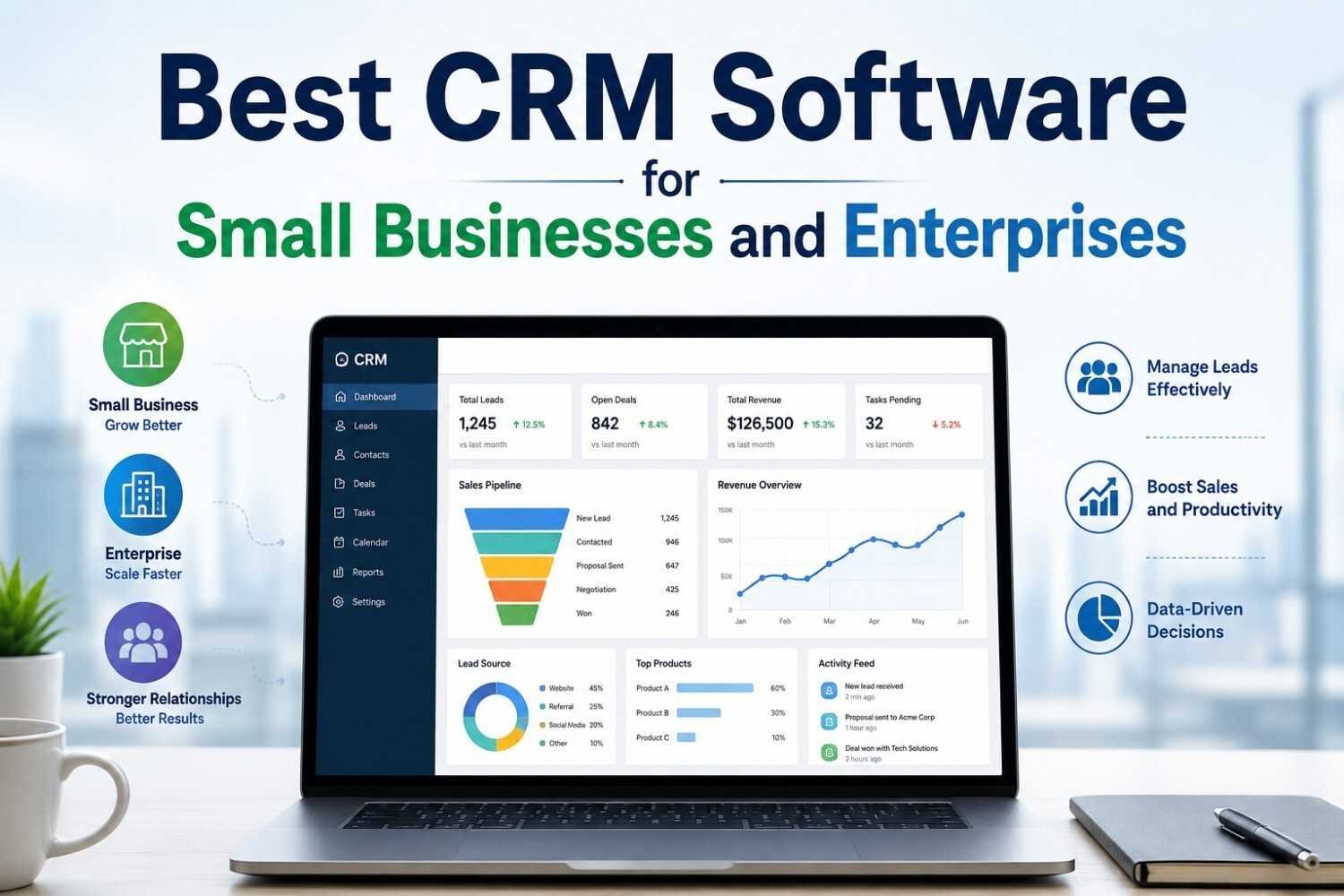
Managing customer relationships has become one of the biggest challenges for businesses in today's competitive market. Whether you own a startup, a small business, or a large enterprise, having the best CRM software can significantly improve customer engagement, increase sales, automate repetitive tasks, and boost team productivity.
Modern CRM software is no longer just a contact management tool. Today's AI-powered CRM platforms help businesses automate sales pipelines, analyze customer behavior, predict revenue, improve marketing campaigns, and deliver exceptional customer support.
What is CRM Software?
CRM (Customer Relationship Management) software is a business solution designed to organize customer information, manage leads, track sales, automate workflows, and improve communication between companies and their customers.
A modern CRM allows businesses to store customer information, track sales opportunities, automate follow-ups, manage marketing campaigns, improve customer service, generate reports, and increase revenue.
Why Every Business Needs CRM Software
Businesses lose thousands of potential customers every year because they don't properly manage leads. A CRM system helps you never lose a lead, track every customer interaction, increase conversion rates, improve customer satisfaction, boost sales productivity, automate repetitive work, generate real-time reports, and improve team collaboration.
Key Features of the Best CRM Software
1. Lead Management
Capture leads from website, Facebook Ads, Google Ads, landing pages, and email campaigns. Automatically assign leads to your sales team.
2. Sales Pipeline Management
Visual sales pipelines help monitor every customer journey from inquiry to purchase. Benefits include deal tracking, revenue forecasting, stage management, and conversion analysis.
3. AI Automation
The latest AI-powered CRM systems offer automatic email responses, AI-generated follow-ups, smart reminders, customer sentiment analysis, and sales predictions. AI automation saves businesses hundreds of hours annually.
4. Contact Management
Store customer details including name, phone number, email, company, purchase history, and communication timeline. Everything stays organized in one place.
5. Marketing Automation
Advanced CRM software integrates with email marketing, SMS marketing, WhatsApp, Facebook, Instagram, and Google Ads to nurture leads automatically.
6. Customer Support
Many CRM platforms include ticket management, live chat, help desk, knowledge base, and AI chatbots to improve customer satisfaction while reducing response times.
Benefits of CRM Software
- Higher Sales – Better lead management and streamlined processes improve sales performance.
- Better Customer Relationships – Personalized communication increases customer loyalty.
- Improved Team Productivity – Automation reduces manual tasks.
- Better Decision Making – Analytics dashboards provide valuable business insights.
- Increased ROI – Reduce operational costs while improving revenue.
CRM Software Features Comparison
| Feature | Small Business | Enterprise |
|---|---|---|
| Contact Management | ✅ | ✅ |
| AI Automation | ✅ | ✅ |
| Sales Pipeline | ✅ | ✅ |
| Marketing Automation | ✅ | ✅ |
| Analytics | ✅ | Advanced |
| API Integration | Limited | Full |
| Custom Workflows | Basic | Advanced |
| Security | Standard | Enterprise Grade |
CRM Software for Small Businesses
Small businesses should prioritize affordable pricing, easy setup, mobile access, email integration, automation, and lead tracking. A lightweight CRM reduces complexity while improving efficiency.
CRM Software for Enterprises
Large organizations require advanced security, multiple departments, workflow automation, AI insights, global access, ERP integration, API support, and role management. Enterprise CRM platforms support thousands of users and complex operations.
Cloud CRM vs On-Premise CRM
Cloud CRM
Advantages: Lower cost, remote access, automatic updates, fast deployment, and scalable.
On-Premise CRM
Advantages: Full control, custom security, and internal hosting. Disadvantages include higher setup costs and ongoing maintenance.
How to Choose the Best CRM Software
Before purchasing, evaluate budget, team size, integration with email, ERP, accounting software, marketing tools, and payment systems, AI features, and customer support.
Future of CRM Software
- Artificial Intelligence
- Predictive Analytics
- Voice Assistants
- Conversational AI
- Workflow Automation
- Customer Journey Mapping
- Hyper Personalization
- Real-Time Analytics
Frequently Asked Questions
Which CRM software is best for small businesses?
The best CRM software depends on your budget, required features, and growth plans. Many cloud-based CRM solutions offer affordable pricing, automation, and scalability suitable for small businesses.
Is CRM software worth it?
Yes. CRM software helps improve customer relationships, increase sales efficiency, automate workflows, and provide valuable business insights, making it a worthwhile investment for businesses of all sizes.
What is the difference between CRM and ERP?
CRM focuses on customer relationships, sales, and marketing, while ERP manages internal business operations such as finance, inventory, procurement, and manufacturing.
Conclusion
Choosing the Best CRM Software for Small Businesses and Enterprises is a strategic decision that can transform the way you manage customers, streamline operations, and grow revenue. Whether you're a startup looking for an affordable cloud CRM or a large enterprise seeking AI-powered automation and advanced analytics, the right CRM platform can improve productivity, strengthen customer relationships, and support long-term business growth.
As CRM technology continues to evolve with artificial intelligence, predictive analytics, and workflow automation, investing in a scalable, secure, and feature-rich CRM solution will help your business stay competitive in 2026 and beyond.